Collie Parker’s assault on the soldiers
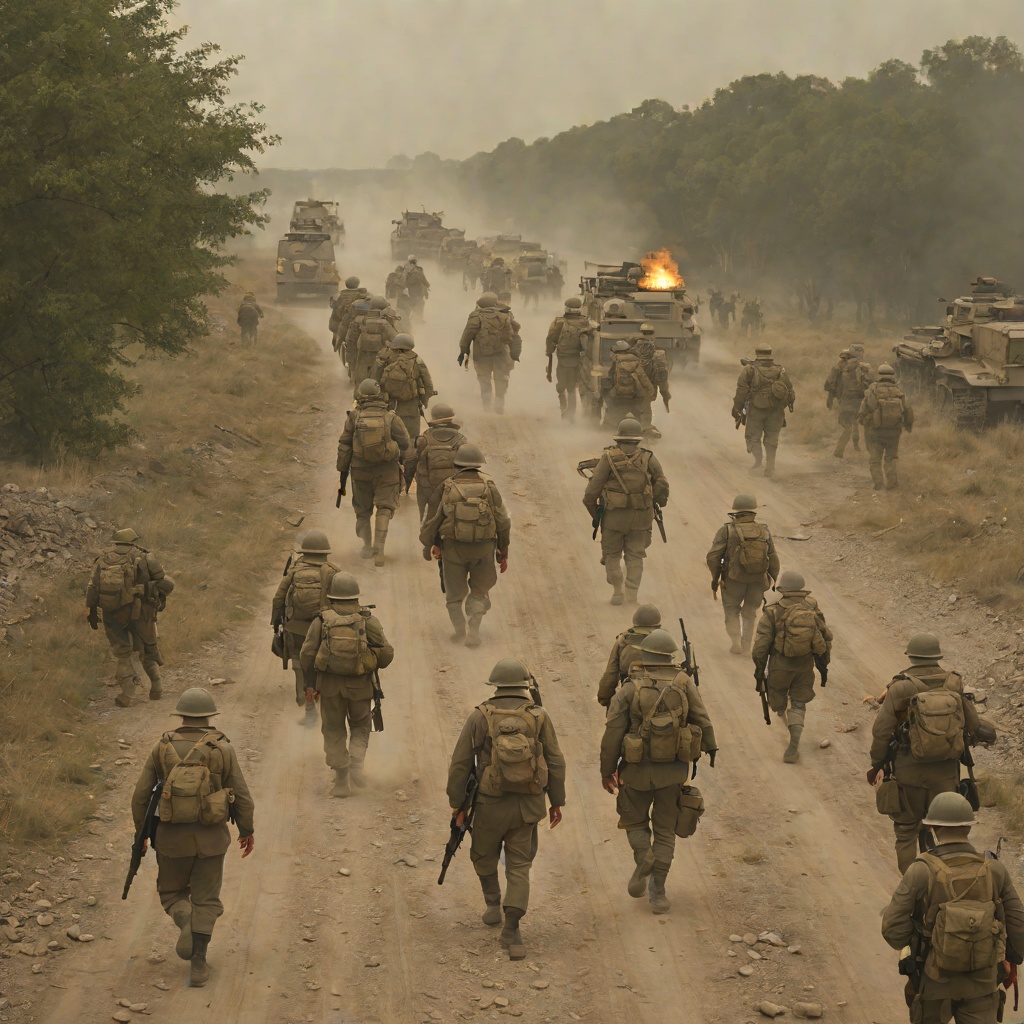
The Long WalkCollie Parker’s assault on the soldiers is the most direct armed rebellion against the machinery of the Long Walk. Parker seizes a rifle on top of the halftrack, kills one soldier, challenges the other Walkers to join him, and is shot from behind before they can act. The event changes the meaning of the Walk: for a moment, the boys are not merely being eliminated one by one, but are presented with the possibility of attacking the system that has made their deaths lawful entertainment.
Causes and Background
The assault occurs after the Walk has already taught its participants to regard death as procedure. Curley’s death reduces a struggling boy to a target on the road: soldiers wait for him to fall below speed, the crowd reacts with shock, and four carbines turn his body into a spectacle. Ewing is shot at close range after soldiers drag him away from the group, while Travin is killed with his pants down after repeated warnings caused by diarrhea. These earlier executions establish the pattern Parker interrupts: bodily failure is interpreted as disobedience, warnings become a countdown, and the soldiers’ rifles make the rule final.
The Walkers are also being reduced to numerical and administrative identities. At the beginning, Ray Garraty’s blue plastic identification card is fed into a computer terminal, which displays his registered name and address. The state therefore knows the boys as records before it treats them as competitors. Once the Walk begins, however, the individual is increasingly represented by warnings, position, speed, and survival statistics. The soldiers’ surveillance is constant, and the Major’s formal gesture of luck gives the violence a ceremonial surface. Parker’s assault attacks not only armed men but the apparatus that converts living boys into regulated bodies.
The Assault
Parker appears suddenly on top of the halftrack during a stretch in which Ray Garraty has fallen into a melancholy that he finds strangely satisfying. The interruption comes as an irregular rattle of gunfire and hoarse screams from the crowd. One soldier lies on the ground, staring upward with empty eyes; a neat blue hole, ringed by powder burns, marks the center of his forehead. Parker is holding the soldier’s rifle, making the halftrack itself the scene of an inversion: the vehicle that carries the executioners has briefly become the platform of an insurgent.
Parker shouts, "Goddam bastards!" and then calls to the Walkers, "Come on, you guys! Come on! We can-" His unfinished appeal is crucial. He does not present the attack as a private escape attempt. He tries to convert individual fear into collective action, imagining that the boys can act together against the soldiers. Yet the Walkers, including Garraty, stare at him as though he has begun speaking a foreign language. Their inability to respond shows how thoroughly the race has isolated them from one another, even though they are subjected to the same threat.
The soldiers react with disciplined speed. One of the men who had jumped from the halftrack when Parker climbed up carefully shoots him in the back. McVries alone seems immediately to understand the scale of the lost opportunity and cries out Parker’s name, recognizing that the assault might have become a shared revolt. Parker remains standing despite the wound, his torn khaki shirt and blue jeans covered with his own intestines. The image strips away the distance between military uniform and civilian body: the soldiers’ clothing represents organized authority, while Parker’s exposed body reveals the material cost of challenging it.
Parker fires the stolen rifle twice into the road. The bullets snap and whine, and one passes close enough to tug the air before Garraty’s face; someone in the crowd screams in pain. The rebellion therefore does not remain symbolically contained. Parker’s resistance threatens the spectators as well as the soldiers, and the crowd’s position is exposed as unstable: it watches the violence, but can also be caught by it. After the shots, Parker loses control of the rifle, makes an almost military half-turn, and falls to the road, panting like a mortally wounded dog.
Death and Immediate Aftermath
Parker tries to force out a final statement through the blood in his mouth, but the words break apart into "You. Ba. Bas. Bast. Ba." He dies staring viciously at the Walkers as they pass. The broken coda is not a clean political speech; it is the damaged remainder of a protest that the state has interrupted before it can become fully articulate. His death leaves Garraty asking what happened, while McVries explains that Parker must have known he could not win and had therefore crept up behind the soldiers while they were inattentive.
McVries also supplies the event’s most painful interpretation: Parker wanted all the Walkers to join him, and they might have succeeded. That possibility cannot be verified, but within the scene it functions as a judgment on the group. The soldiers defeat Parker physically, yet the deeper defeat has already occurred when the Walkers look at his appeal without understanding how to answer it. Their fear has become a form of discipline. They continue walking past the body because continuing is the only action the rules recognize as survival.
Meaning Within the Long Walk
Parker’s assault reverses the ordinary direction of power. Normally, the soldiers watch, warn, drag, and shoot; the Walkers endure, calculate their pace, and try to conserve enough strength to avoid the next warning. Parker seizes the rifle and makes the soldiers visible as vulnerable men rather than an impersonal execution mechanism. The reversal lasts only moments, but it proves that the system is not invulnerable in a purely physical sense. Its strength depends on the Walkers’ isolation, obedience, and inability to imagine coordinated refusal.
The event also clarifies the difference between formal legality and lived coercion. The Walk is presented through identification checks, timing, warnings, and the authority of the Major, but its practical rule is that a boy may be shot when his body can no longer satisfy the required pace. The soldiers’ violence is therefore both public and procedural. Parker’s attack is condemned by the same structure he attacks, yet the scene gives no competing legal or moral forum in which he can be heard. He is permitted to participate, permitted to walk, and permitted to die; he is not permitted to challenge the terms that define those permissions.
Parker’s rebellion contrasts with the passive endurance of other deaths. Olson, after being shot while climbing the halftrack, continues staggering along with his intestines slipping through his hands, while a young soldier remains ready to deliver the next warning. Garraty later finds himself alone beneath the gaze of a blond soldier holding a chronometer and rifle, and the Major approaches in a jeep to offer the Prize after the remaining competitors have been destroyed. Against this continuing mechanism, Parker’s action is a violent refusal to remain only an object of observation. Its failure makes the refusal tragic, but its very occurrence prevents the Long Walk from appearing as a perfectly closed system.
Narrative and Thematic Significance
The assault is a decisive value reversal: the Walkers’ apparent security within the group becomes helpless spectatorship, while Parker’s apparent isolation becomes active agency. His death restores the soldiers’ control, but it cannot erase the image of a Walker standing on the halftrack with a rifle or the recognition, voiced by McVries, that collective resistance might have changed the outcome. The scene thus links physical exhaustion to political paralysis. The boys are not simply prevented from rebelling by guns; they have been trained by the race to experience rebellion as incomprehensible.
Parker’s final failure also deepens the book’s recurring concern with witnessing. Garraty watches executions, bodies, weapons, crowds, and warnings, and each act of watching risks becoming participation through silence. When Parker calls for help, Garraty does not move; when Parker dies, Garraty continues walking. The event therefore leaves behind no institutional change and no surviving insurgent organization. Its consequence is instead an exposed moral fact: the state can make condemned people observe one another’s destruction until even an invitation to fight sounds like a foreign language.